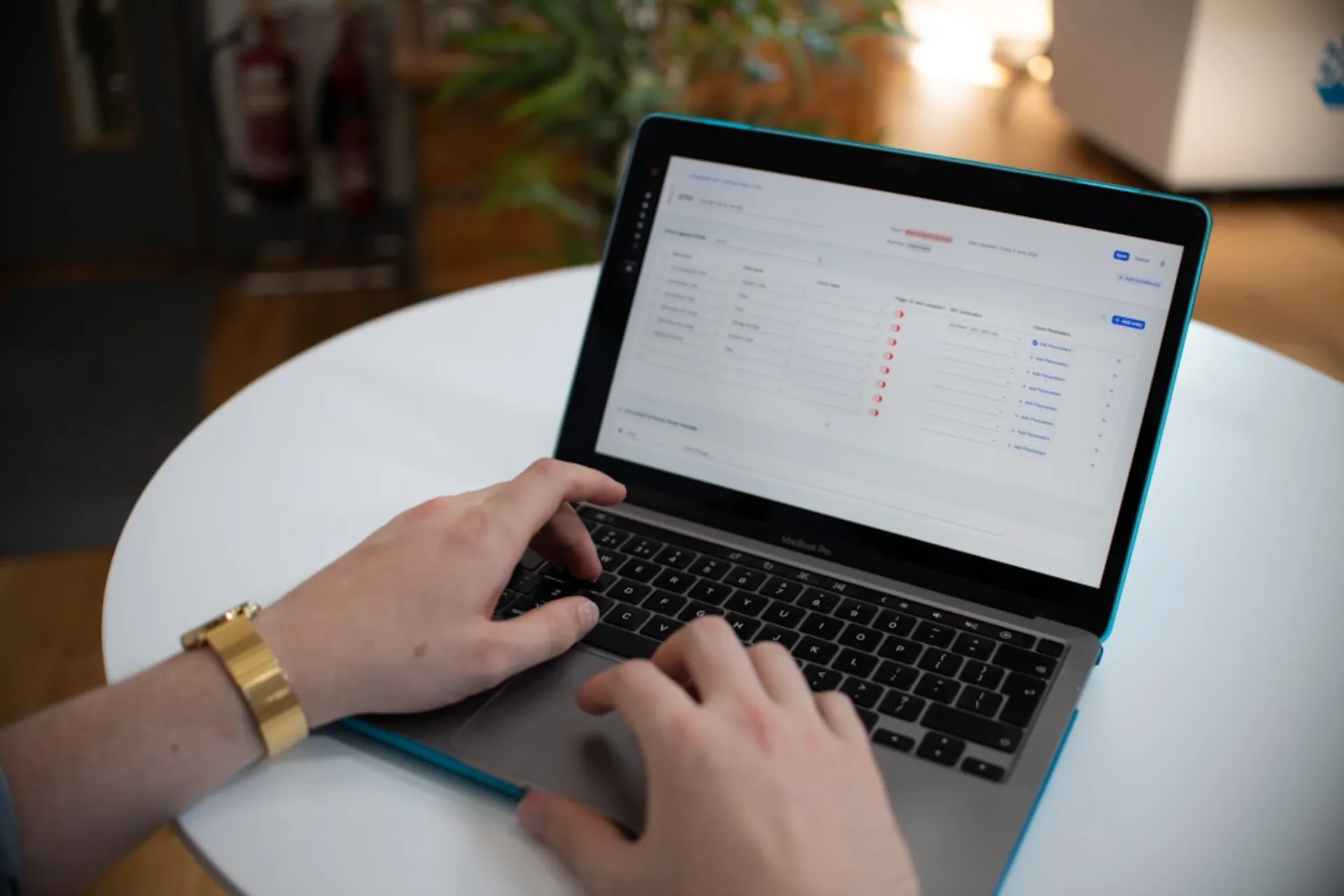
ZTABS builds workflow automation for Austin enterprises scaling beyond manual processes. SaaS companies, Texas state agencies, construction firms and healthcare organisations process thousands of handoffs daily through email, spreadsheets and disconnected systems. ZTABS is remote-first by design from our Houston, Texas office, combining operational knowledge with engineering-depth automation.
Workflow automation in Austin eliminates the manual routing, data re-entry and approval chasing that limit how fast Austin organisations can operate. The city's SaaS companies, state government agencies, construction market and healthcare systems each face distinct automation challenges.
Workflow automation in Austin at a glance
| Need | What we build | Key consideration |
|---|
| SaaS operations | Quote-to-cash, onboarding, financial close | CPQ, billing, CRM integration |
| Government | Permit processing, benefit determination, filing | Texas agency procurement, TX-RAMP |
| Construction | Pay applications, change orders, inspections | Multi-party coordination |
| Healthcare | Prior auth, referrals, claims processing | HIPAA BA chain, payer integration |
| Integration | API connections, orchestration, data sync | Existing ERP, CRM, accounting |
SaaS revenue operations
Austin SaaS companies build sophisticated products for customers while running internal operations on manual processes. Quote-to-cash workflows, employee onboarding and monthly financial close consume operations staff time that scales linearly with company growth.
Quote-to-cash automation. Connecting CPQ configuration to contract management, billing and revenue recognition. When a deal closes, automation creates the subscription in the billing system, provisions the customer account, triggers the onboarding sequence and updates revenue forecasting. Manual quote-to-cash processes involving data copied between Salesforce, contract tools, Stripe and accounting systems introduce pricing errors, billing discrepancies and provisioning delays.
Financial close automation. Monthly close at growing SaaS companies requires pulling data from billing, CRM, payroll and banking, reconciling and producing financial statements. Automation assembles the data, performs standard reconciliations, flags variances exceeding thresholds and generates the close package. The controller reviews and approves rather than compiling from scratch. Close cycles consuming multiple business days at growing SaaS companies can be reduced to the judgment-based activities that genuinely require human attention.
Customer onboarding. When a new customer signs, automation provisions their account, sends welcome communications, schedules kickoff calls, assigns the customer success manager and initiates the onboarding checklist. Consistent automated onboarding reduces time-to-value and reduces variation in onboarding quality across team members.
Scaling your Austin SaaS operations?
Tell us about your quote-to-cash process, system stack and monthly volume. We start with the workflow that delivers the most value and expand from there.
Texas government workflows
Austin is the state capital, and dozens of state agencies maintain headquarters or major operations here. These agencies process millions of transactions annually through processes designed for paper-based workflows and partially digitised without fundamental redesign.
Permit and licence processing. Automating application intake, completeness checking, eligibility verification, assignment to reviewers and status tracking. Automation reduces processing backlogs by handling routine validation and routing while directing complex cases to appropriate staff with full application context.
Benefit determination. Automating eligibility calculations for benefit programmes based on verified income, household size and programme criteria. Automation applies defined rules consistently and routes exceptions requiring judgment to caseworkers with supporting evidence assembled.
Inter-agency data sharing. Eliminating manual data re-entry when a constituent's case involves multiple agencies. Automated workflows share verified information between agency systems with appropriate consent and audit trail, reducing the burden on both constituents and agency staff.
ERCOT and energy data. Austin Energy and ERCOT market participants require meter data processing, outage management workflows and regulatory reporting. Automated workflows ingest and validate operational data, track status changes and compile required reports. ERCOT data access requires specific licence agreements and compliance with operational technology safety requirements. Read-only monitoring protocols do not inherently provide the isolation of a physical data diode.
Construction coordination
Austin's construction market runs on paper-heavy processes with multi-party workflows spanning general contractors, subcontractors, architects, engineers and government inspectors.
Pay application processing. Automating the monthly payment chain from subcontractor submission through general contractor review to owner approval. Automation tracks submission status, flags discrepancies against contract terms and routes approvals. Manual pay application processes involving email chains and phone calls accumulate delays at each verification step. Automation reduces the administrative overhead by automating routing and status tracking.
Change order approval. Multi-party approval workflows currently running on email and phone calls. Automation routes change order documentation to each approver with supporting context, tracks response deadlines and escalates stalled approvals.
Inspection scheduling. Coordinating city inspectors, third-party testing labs and project schedules through automated scheduling and confirmation. Replacing individual phone calls with centrally managed scheduling workflows that maintain current availability and send confirmations.
Healthcare administration
Central Texas healthcare systems process insurance verification, referral management, claims and patient intake through manual workflows that consume administrative capacity.
Prior authorisation. Automating authorisation requests with clinical documentation assembly, payer submission and status tracking. Automation submits authorisation requests with assembled clinical documentation rather than discovering requirements at billing. HIPAA applies to covered providers conducting standard electronic transactions. Business associate agreements must chain through the complete data handling pathway.
Claims processing. Charges captured from clinical documentation flow through coding validation, claim scrubbing against payer-specific rules and electronic submission. Automation reduces the lag between service and clean claim submission, catching common denial triggers before filing.
Referral management. Automating referral generation from the EMR, prior authorisation submission, status tracking and appointment coordination. Replacing fax-and-phone processes that lose referrals and delay specialist care.
Compliance and regulatory considerations
TDPSA scope. The Texas Data Privacy and Security Act applies to consumer individuals and households, excluding commercial and employment contexts. Entity exemptions apply to certain businesses. Under section 541.002(a)(3), SBA-defined small businesses are excluded from ordinary chapter controller duties, except that section 541.107 survives: those small businesses must still obtain prior consent before selling sensitive personal data. That is the specific carveout, not a general imposition of all controller obligations on small businesses. Workflow automation handling consumer personal data implements appropriate controls based on the actual statutory scope, entity exemptions and data-type exclusions.
HIPAA requirements. HIPAA applies to standard-transaction covered providers, health plans, clearinghouses and their business associates handling PHI. The treatment minimum-necessary exception applies to disclosures to and requests by providers for treatment, not every internal use. Addressable security specifications require a documented assessment: implement the specification when reasonable and appropriate; if not, document the rationale and implement an equivalent alternative measure if reasonable and appropriate; document the justification where neither is reasonable and appropriate. Business associate agreements chain through the entire data handling pathway.
DIR TX-RAMP. Applies to Texas state agency, higher education institution and public community college cloud procurement for the specific cloud offering. It does not cover all local government automation, advisory work or private-sector workflow projects. Engagements serving state entities should confirm the applicable TX-RAMP requirements for the specific cloud offering.
How delivery works
ZTABS is remote-first by design from our Houston, Texas office. Austin engagement operates within the Central time zone with responsive communication and rapid iteration cycles.
Process discovery. Documenting current workflows by observation, stakeholder interviews and system analysis. Identifying every step, decision point, handoff and exception in the actual process. Discovery frequently reveals that a disproportionate share of manual effort concentrates on the minority of cases outside standard rules.
Automation boundary design. Classifying each step as fully automatable, assistable or manual based on rule consistency, judgment requirements and system availability. This classification determines where automation handles processing and where humans make decisions with automated context assembly.
Platform selection. Zapier for straightforward SaaS connections. Make for complex multi-step workflows with branching logic. n8n self-hosted for infrastructure control and custom code execution; actual execution limits, self-hosting rights and features depend on the n8n edition and plan. Custom Node.js or Python for high-volume, performance-critical or compliance-specific workflows.
Trigger and event semantics. Workflows triggered by events such as deal closure, application submission or status changes must handle stale events, duplicate events and out-of-order delivery. Event deduplication with idempotency keys, bounded retry with backoff and timeout, and receiving-system idempotent processing prevent duplicate external effects. Workflow state alone does not guarantee exactly-once delivery to external systems.
Human approval boundaries. Workflows involving financial transactions, regulatory filing or irreversible actions include human approval gates at defined thresholds. Automation routes work and assembles context; humans make the decision with full visibility.
Deterministic rules versus AI inference. Rule-based workflow steps execute deterministically with predictable, auditable outcomes. AI-assisted classification, extraction or routing components introduce uncertainty requiring confidence thresholds, escalation paths and human review for low-confidence cases. For AI-assisted components, representative held-out evaluation and simpler baseline comparison validate performance. Retrieved content and tool outputs cannot grant permissions beyond the authenticated user's access.
Secrets and credential management. Automated workflows connecting to external systems manage API keys, service accounts and credentials with rotation schedules, least-privilege access and secure storage. Separate test and production credentials prevent staging data from reaching production systems.
Monitoring and observability. Real-time dashboards showing workflow execution counts, success rates, error rates, processing times and bottleneck identification. Observable failure rates, concurrent execution limits, API rate quotas and budget consumption are configured and monitored.
Illustrative Example
Hypothetical: Austin SaaS company automating revenue operations
A B2B SaaS company at $20M ARR with 1,500 customers finds that its five-person RevOps team spends a large proportion of time on manual data transfers between CRM, billing and accounting systems. Quote pricing requires checking a separate spreadsheet. Customer provisioning takes two business days after contract signature because it waits on an engineering team's manual account creation.
Automation would connect quote configuration to pricing rules in the CRM, eliminating the external spreadsheet. Contract signature would trigger automated billing subscription creation, customer provisioning and onboarding sequence initiation. Monthly close data compilation would be automated with the controller reviewing assembled packages rather than compiling from multiple sources.
Assumptions: all systems provide API access, pricing rules can be encoded without frequent exceptions, and the team can invest four to six weeks in process redesign before automation. Residual risks include API changes requiring integration maintenance, edge cases in complex enterprise contracts needing manual handling, and the ongoing cost of monitoring and updating automations as business rules evolve.
This is a hypothetical scenario for illustration. Actual scope, timeline and cost depend on your requirements.
Cost and timeline
Custom workflow automation follows the published cost guide. These are planning ranges for custom build scope, not minimums for every configuration task.
| Tier | Range | Timeline | Example |
|---|
| Internal Tool | $25K to $60K | 6 to 14 weeks | Single-purpose dashboard, form processor, workflow automation |
| Business Application | $60K to $150K | 14 to 28 weeks | Multi-role application with integrations and business logic |
| Enterprise Platform | $150K to $300K | 28 to 40 weeks | Complex platform with compliance, multi-tenant and analytics |
| Large-Scale System | $300K to $500K+ | 40 to 60+ weeks | Mission-critical system with high availability and DR |
Optional recurring costs depend on actual platform edition, plan tier, execution volume and support contract. Ongoing support depends on scope and SLA requirements.
2026 US business application planning benchmark
A representative 2026 US business-application build at this scope typically involves multi-role access with SAML or OIDC single sign-on, a workflow engine orchestrating approval chains, ERP and HRIS integrations, audit logging, and applicable SOC 2 or HIPAA readiness preparation where the engagement requires it. That combination touches front-end, back-end, integration, infrastructure and compliance architecture work. The Business Application and Enterprise Platform tiers in the table above reflect this benchmark scope.
Budget look right for your Austin project?
Share your workflow requirements, system landscape and timeline. We provide a scoped estimate based on the published guide ranges.
Evaluating a workflow automation proposal
Use these six criteria to compare any vendor proposal, including ours.
| Criterion | What to verify |
|---|
| Scope, deliverables and acceptance | Written scope with named deliverables, acceptance criteria and what is explicitly excluded |
| Data, integration and action authority | Which systems are accessed, what credentials or licences are required, who retains data ownership, and which party holds filing, payment or clinical action authority for each external system |
| Baselines, evaluation and acceptance | Current-state metrics, how improvement will be measured, held-out evaluation when AI components are used, and conditions for accepting each milestone |
| Operational exception, reconciliation and support | How the system handles partial failures, duplicate events, unknown-outcome reconciliation, operating handover and after-hours incidents |
| Staff and user languages, resources and coverage | Agreed staff, user and documentation languages, translation and review resources, tested locale and template coverage, and key personnel commitments |
| Commercial terms, change control and exit | Payment schedule, change-order process, IP ownership and data-export provisions at contract end |
When this engagement is not the right fit
- An existing platform already covers the workflow scope. If Zapier or an existing SaaS tool handles the need with minor configuration, configure that first. Custom automation makes sense when off-the-shelf genuinely fails.
- The engagement requires on-site embedded staff. ZTABS is remote-first by design. If the proposed engagement requires daily on-site coverage, the customer should arrange an on-site team or select a provider who offers that model.
- The scope is single-platform RPA only. If the need is screen-scraping automation within one legacy application, a dedicated RPA vendor such as UiPath or Automation Anywhere may be more appropriate for that specific scope.
- The engagement requires specific procurement certifications the customer has not sourced. If DIR TX-RAMP certification is required for the specific cloud offering, the customer should confirm that the selected provider holds the applicable certification or provisional route for that offering.
Risks and mitigations
Automating a broken process. Automation makes a bad process run faster, producing bad outcomes more quickly. Process discovery and redesign before automation eliminates unnecessary steps and fixes routing issues.
Scope creep during implementation. Each workflow discovered during mapping suggests three more. Lock scope with a written change-control process. Every new workflow is a separate phase, not a free addition.
Integration fragility. API changes, rate limits and schema updates can break automations. Monitoring, alerting and retry logic detect and escalate failures, reducing the risk of silent propagation. Maintenance plans include integration health checks.
Irreversible external effects. Automated emails, payments and regulatory submissions cannot be automatically undone. Approval gates before irreversible actions and dry-run modes during initial deployment reduce exposure.
Reconciliation gaps. Workflows touching multiple external systems must handle partial success and unknown outcomes. Reconciling acknowledgments and partial completions before replay prevents duplicate payments, filings or notifications.
Ongoing support model
Post-deployment support covers platform management, workflow optimisation, integration maintenance and expansion planning. Monthly automation reports show execution volumes, error rates, processing times and business impact. Continuous improvement refines triggers, business rules and exception handling based on production experience.
Operating handover. Documentation for ongoing operation, exception handling and troubleshooting. Recovery drills validate that the client's team can diagnose and resolve common failure modes independently. The goal is operational independence, not ongoing consultant dependency.
Ready to automate your Austin operations?
Tell us about your highest-volume manual processes, compliance requirements and existing systems. We start with process discovery and build from the workflows that deliver the most value.